Showing posts with label Start-up. Show all posts

Saturday, July 16, 2011

Solenoid Problem

A day after our first beer went into the fermenter we realized that there was another problem with our glycol system.  Originally, we thought the only problem was that we couldn’t get our tanks below 38 – 40 degrees in any reasonable amount of time.  However, we also found out that once we set our temperature control to the desired temperature it would continue to cool pass the point.

The way the system works is that once the temperature inside the tank reaches the set point programmed into the controller it should close, therefore preventing cold glycol from entering the tanks.  Once the temperature begins to rise, the valve will open again and allow glycol in to cool the contents of the tank. 

We had our first fermenter set at 64 degrees.  Once it got down to that temperature we assumed the valve would shut and cooling would stop.  When we came in the next morning our unfermented beer was sitting at 55 degrees.  For some reason the tanks continued to cool past the set point.  

We called some of the people that had been helping us with this problem.  They told us the most likely reason was that there was glycol getting past the solenoid valve.  They said it was possible that the valve was damaged during installation so we took it apart and check the condition.  What we found out was that the plumber, who had been causing all these problems for us already, installed the valve backwards.  

It’s easy to tell because anyone who understands how this system works knows that the glycol comes into the valve from the top and out through the bottom.  As you can see in the picture the “out” is on top and the “in” is on the bottom.  We checked and sure enough all the tanks were piped this way.  


We got someone in the next day to rebuild and reinstall all the valves properly and the problem was corrected.  Fortunately, we were able to warm up the tank back up to 64 and fermentation kicked in with in a few hours.  Since the other two tanks were still empty we didn’t have to worry them. 

Unfortunately, that didn’t solve the problem of getting the tank down below 38, but at least we fixed one of the major issues.       

Thursday, July 7, 2011

Glycol System Down

While we were waiting to get our brewing license from the NJ ABC we cleaned and passivated our new stainless steel fermentation tanks.  After that we decided to fill the tanks with water to test how fast they cooled down to conditioning temperature so would have an idea of cooling rates.  We had started up the chiller before to test it, but once it seemed to be working fine we shut it down.  We ran the chiller over night, which was the first time we left it running for any length of time.  

When we came back in the morning the chiller had tripped a low pressure setting and stopped working so our tanks never got cold which clearly indicated a problem with the system.  We spent the next few days working on the phone with the chiller manufacturer, our equipment supplier and neither had any idea what was causing the problem.  We kept trying solutions but the pressure would always drop tripping the cut off before we would get the temperature down.  Finally we narrowed the problem down to an issue with the flow. 

While we were trying to solve this problem, we got the word from NJ ABC that we could start brewing.  So now we were officially able to brew but couldn’t until we fixed this issue. 

We called in a refrigeration specialist down to see if he could troubleshoot the problem.   He thought it might be a faulty valve so we replaced it in the hopes that it would fix the problem. It helped, but unfortunately the flow rate was still restricted enough that the system wouldn’t work.  

On top of that it was a holiday weekend, so we had to wait until Tuesday to try anything new.  We were told to try and bleed some air out of the system over the weekend and that may help.  By Tuesday the system still wasn’t working right.
    
After checking every part in the chiller unit and finding nothing wrong we decided that the restriction had to be from too much air trapped in the pipes.  We decided to add another air eliminator to the other part of the piping where the air seemed trapped to increase the flow.  Once we added that, it allowed the air to slowly drain from the part of the system that it was trapped in and the tanks began to cool a bit.  

Ultimately the problem was poor piping layout and a faulty start up, both handed by our plumber / steam guy.  When he built the system he put in a ton of unnecessary elbow and turns where air could get trapped and when he started it up he didn’t flush out the air before filling it with glycol.  This caused large amounts of air to get caught in the jackets and piping.

Once the additional eliminator was added the chiller started working great, but now we have to wait for all the air to drain out of the system and see if the problem corrects itself.  

Wednesday, July 6, 2011

Drive In Cooler

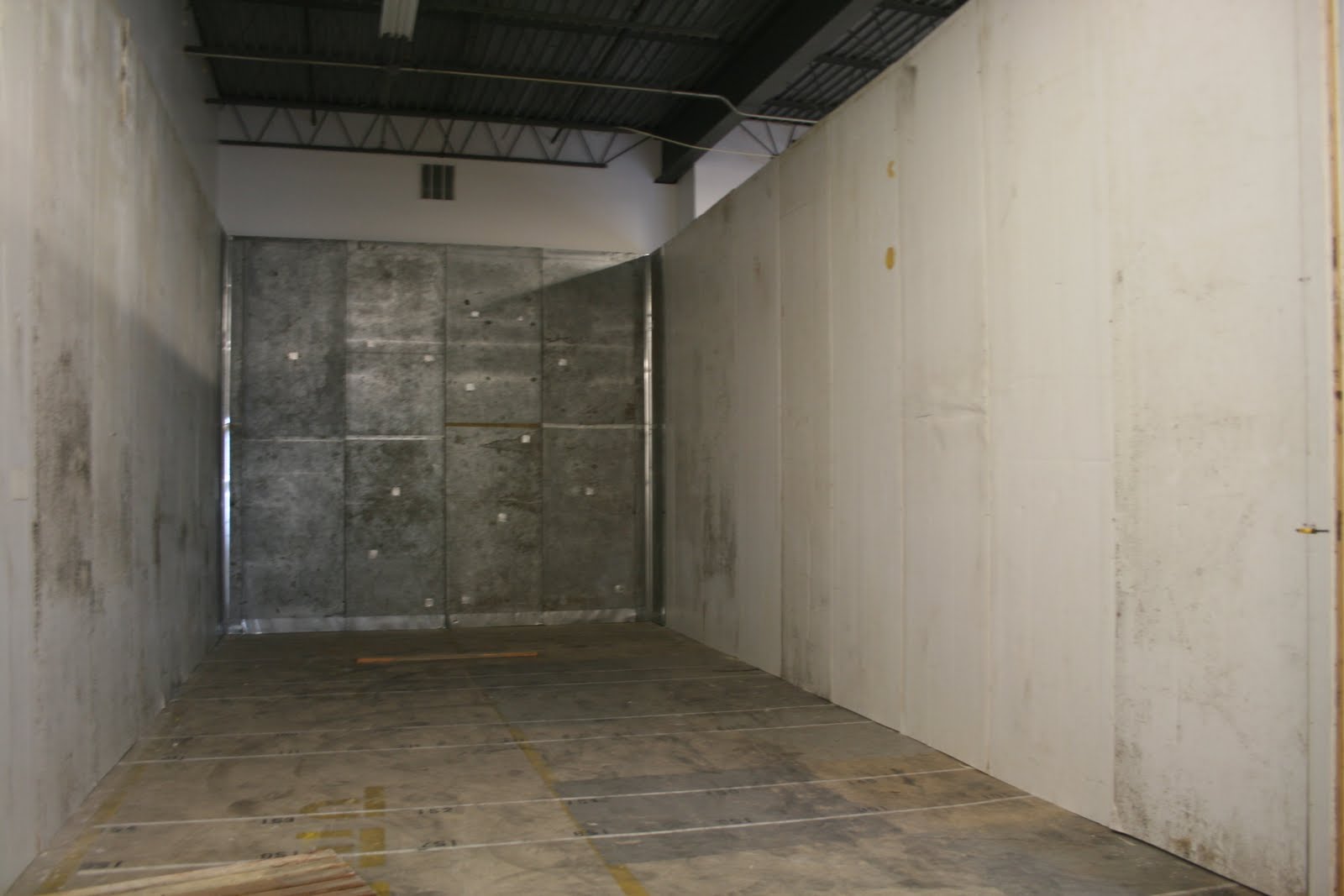
The other massive project we tackled while we were working to get the brew house up and running was construction of our walk in cooler.  We pretty much bought the largest cooler we could afford and that would fit into our space.  The reason we wanted a larger cold space is that since we are self-distributing our beers we will be storing them until on site until we deliver them to retail accounts.  Since we won’t be shipping our kegs off to a distributor in bulk once they are packaged we wanted a large enough space to keep all our beer stored cold.  We also wanted to have enough space to properly age some kegs and / or barrels.  

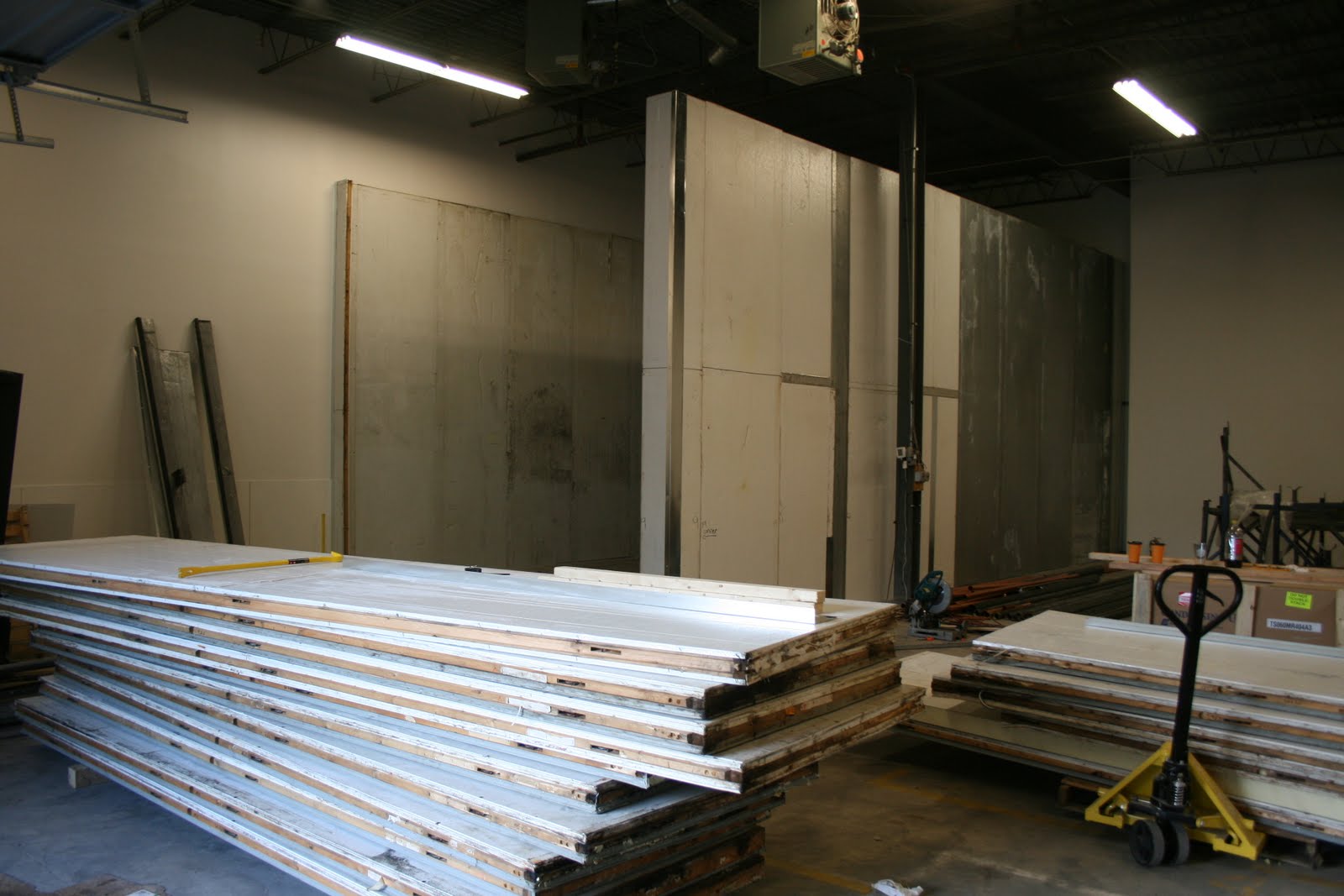
We ended up getting a used box that was 36 feet long, 18 feet wide and 16 feet tall.  It’s about 650 square feet of cold box goodness.  We realized once it was up that it was larger than the last apartment my wife and I shared in the city by about 150 square feet—and we lived there for five years.  It should be a good home for our kegged beer, hops and anything we plan to age.  Since we bought it used, it was delivered to us as a stack of loose panels in the back of a tractor trailer.


It took us about three hours to get the massive 8x8 door and about forty 16x4 panels unloaded by hand off the truck.  At least this gave the driver a chance to take a nice afternoon nap in the cab.   


As you can see from the photo organizing the panels happened another day. Getting the box built was one of the more difficult things we had to do.  We were told the box is self supporting and that each panel locks into the one next to it.  It’s true that the panels lock into one and other, but that’s only true if the locks work.  It also seemed that it would be better to add some type of support to hold the roof up.  This ended up taking the most time.  

We started by getting the three walls built, then we planned to add the roof, then the front with the door.  The cold box doors supported by our warehouse walls were not that difficult to get up, but the free standing walls were a little more difficult. 


Because the panels are 16 feet tall they were difficult to stand up and get into place without tipping over.  Again, the forklift was crucial in getting these into place. 


After getting the outer walls built we lifted the ceiling panels on with the forklift.   We chose to support them with threaded rod and unistruts from the existing roof but this took a while

.  


Once we finally got the ceiling on, we needed to cut a few panels to build in a space for the door then hang the surprisingly heavy sliding door on the tracks.  After that we brought  in a refrigeration guy to hook the cooling unit up and we were on our way. Two quick coats of white paint and the box was finished.  

Tuesday, July 5, 2011

Construction Completed

We spent the last month working with contractors and our DME representative to get the brew house installed and connected to the required utilities.  The DME representative, Paul, showed up right before Memorial Day and was here for 10 days.  The plan was to have all the DME equipment set up and utilities connected to the equipment so that we could perform a test brew with water and check the glycol system before he left.

The way it usually works with these type of installs is that Paul plans to come to the brewery when the steam, electrical, and water is a few days from being finished so that he can answer any questions the contractors have about getting the systems hooked up to the brewing equipment then he will have a few days to test and troubleshot any issues before he leaves. We coordinated the timing of his trip with our contractors to make sure we would be able to get all this done in ten days.


The most complicated part of the install was getting the steam system for the kettle and hot liquor tanks up and running.   The steam guys started a few weeks before Paul got here so that they would be ready for the test brew.


The first few days that Paul was here we spent getting the tanks in their final positions and getting them level and running the pipe water, steam, and electrical to them.  Once that was done we could connect the stainless piping that connects the mash tun, kettle and pumps on the brew house.


Once that was done we spent some time getting the plates into the mash / lauter tun and getting the rake motor mounted on top. 


Next we worked on getting the grain handling systems set up.  We have an existing room in the warehouse that we were planning to use as a mill room to keep all the grain dust separate from the brew house and cellar.  We realized that we were going to have to raise the ceiling to get all of our equipment in there easily.

We moved our mill, grist case and augurs into the expanded room and got those running.  The way our systems works is that the grain is sent through the wall of the mill room, behind our fermenters along the side wall and over to the mash tun.  


We also finally got the town to sign off on the placement of the chiller behind our building.  So we got the concrete pad poured and got the chiller in place so that when they got around to hooking it up it would be ready to go.


About half way through Paul's time here we realized there was no way the company putting together the boiler and glycol system were going to finish as promised.  They were way behind on the boiler install so we decided that it was better for them to focus solely on the steam and not work on the glycol system at all. 

One of the major mistakes we made was hiring one steam fitting / plumbing company to do both.  They were hired to install the boiler, the domestic water service, and pipe and start-up the glycol chiller.  All things we were told they did numerous times.  At the outset of the project they told us two weeks for everything.  Almost immediately they were behind and never managed to get caught up.  

If we had use two different companies like we had originally planned, we could have had both set-ups going at the same time.  Four weeks in they hadn't finished the boiler or glycol.
 
With a lot of pushing they manged to get the boiler fired up around 7:00 pm the night before Paul was scheduled to leave.  Since the boiler was finally working we were able to fill the tanks with water to clean out the residual oils and dust and check the pumps and piping between the brew house.


After that we filled the hot liquor tank and kettle and made sure the steam was heating both.  We did an hour boil to check the evaporation rates and see how the boiler performed over time.  Since we didn’t have the vent installed yet because of on going delays, we were a little concerned about the steam in the warehouse—mostly making sure we didn’t set off any sprinklers from the heat.   


We opened all the doors and set up a few fans and that seem to take care of any potential issues.  By the time we cooled down the tanks and drained the water we finished up around 3 am.  


The other thing we found out was that our drain worked like a champ, moving water from three tanks out of the brewery with no problem.  Although, there were some minor issues that needed to be fixed, overall the steam system worked fine.

When Paul left we had a working brew house, but we still needed to get the chiller fired up.  It took another week or two for them to get the piping finished.  Once it was ready we spent the better part of a day trying to get the chiller started-up, but once it was up and running it seemed to be working just fine.  There were no leaks in the pipes and the glycol was cooling down by design.  Since we thought that system was working fine they brought in their insulation guy to finish the job.  


While they were insulating the pipes we needed to get some sprinklers moved and a few heads added by request of the fire marshal. When that was done we could get our final fire inspection.  We also managed to pass our final electrical, plumbing and construction inspections.  With that we were able to apply for our Certificate of Occupancy, which we received early last week.  Now that all the construction was completed and we satisfied all the requirements from the town, the only step left was getting our brewing license from the NJ ABC.

Sunday, May 22, 2011

Brewing Equipment In Place


Since all the work on the floor has been completed we can finally move the tanks into position.  We spent the weekend pulling the shipping cradles off the tanks and peeling off the plastic protective covering.  It's great to see all the shiny new stainless in its final location.  


The next few weeks should see a lot of activity around the brewery as we are getting closer to actually brewing.  The DME representative is coming out next week for 10 days to help with the final install and answer any questions the contractors may have regarding steam, plumbing and electrical.  If all goes well we should be in a position to test the operation of the equipment by the end of next week.

Tuesday, April 12, 2011

Next Problem

Now that the floor has been removed we can’t really move ahead on anything else until the rest of our permits are issued.  It has been a few weeks since we got them the names of our contractors so I figured it was a good time to stop over and see where we stood.  We were told that the zoning officer had yet to sign off on the plans and he was leaving in a few days for vacation so we should speak to him if we wanted anything in the next two weeks.

We figured that getting his sign off wouldn’t be a problem.  Back before we signed the lease we spoke extensively with zoning to make sure there wasn’t going to be an issue or a repeat of Manasquan.  After the warm reception in Manasquan one of our top priorities when looking for a new place was that it did not require a zoning variance.  

After a few conversations, we determined that the building was zoned properly and we could move forward with our plan.  The zoning officer told us that they would be required to sign off on any plans for construction but that shouldn’t be a problem now that we cleared from a zoning perspective. 

So we got a hold of the zoning officer, expecting a quick sign-off ,when the first thing they told me after looking at the plans was that I could not put our glycol chiller outside the building where we had planned.  We were told that it appeared as thought a variance would be needed to put the chiller in the parking lot on the side of the building.  

The only way they would know if I needed a variance was if I submitted a site plan of the property including the proposed location of the chiller.  In order to submit a site plan I needed an updated survey of the property—which we didn’t have.  That meant hiring a surveyor and getting an engineer or architect to turn that survey into a site plan.  And that wasn’t the worst part.  We then needed to go before the board the get the variance approved—which would require hiring an attorney and planner to represent us.  Having lived through that process before, I realized that it could take months and cost thousands of dollars.

They claimed the issue was that the chiller would take up space along the side of the parking lot and may obstruct the flow of traffic.  My understanding is that according to code we need 12 feet on both side of the driveway in addition to any space the chiller may take up.  Without an accurate survey and plan they couldn’t tell if there was sufficient room for the unit.  

The best part of this discussion was that there is an existing air conditioning unit next to the proposed chiller location that takes up as much space in the driveway as our new unit would.  The air conditioner has been there since the building was completed in the 1980s without issue.  We were told who ever did that did it without proper permission so it was irrelevant to this matter.  

So now were back to the drawing board on the chiller and we need a solution before the zoning officer goes on vacation or we have to wait another two weeks for permits. 

Friday, April 1, 2011

Chiller Delivery


Our chiller unit arrived today.  We got a 10 hp glycol chiller from ProRefrigeration in Auburn Washington.  Even though we had the specifications on the unit and knew the size, it’s much bigger than we realized.  The units about seven feet tall, six feet long and four feet wide—and weights about 2,000 empty. 

The delivery is good news considering we ordered the unit about nine or ten weeks ago and it’s a critical piece of equipment that keeps our beer cool while its fermenting and carbonating.  The problem is that we were unable to unload the unit because of the way it was shipped.   


As you can see from the picture the only way we could get it off was by picking it up for the side but that would require having a forklift outside or being able to drive our forklift out of warehouse but we don’t have a ramp.  The other option was to drive our forklift onto the trailer, but the gap between our dock and the flatbed was too great to get a 10,000 forklift over. 

What we learned when our brewing equipment was delivered that we could use a pallet jack to pull the delivery or equipment to the end of the flatbed then use the forklift to lift the item into our warehouse from the loading dock.  The problem here was the unit was shipped on a step over the tractor’s back tire.  No one at the shipping company told us it was coming on a step and we didn't think to ask because it never happen before.  

The only real option was to rent a forklift that could pull it off from the outside then move it into our warehouse.  It would be a tremendous waste of time and money to pay for a forklift to be delivered for ten minutes of work, but we really had no choice.  Of course it was 4:00 pm on Friday so after a few phone calls we realized that wasn’t going to happen. 

Luckily a forklift place around the corner, ProLift offered to let us use one of its lifts to move the unit from the step down to the lower part of the flatbed so we could get it off ourselves.  So the we drove the tractor over to their shop and they moved it for us then re-strapped it to the flatbed and we drove it back to the brewery.  From there we pulled it off with our lift.    

Not the best use of three hours on a Friday afternoon, but at least we have our chiller and of course, thanks to the guys at ProLift for helping us out.  

Friday, February 25, 2011

Drawing, Permits & Timelines


Even thought most of our equipment is on its way there is still a ton of stuff that needs to happen before we are going to be in a position to brew any beer.  Major projects like modifying the floor in our brewing area, installing a steam boiler, running water and electrical lines, etc.  In order to start this work we need work permits from the town.  Permits require detailed plans that are signed and sealed by licensed engineers.  That’s where we run into a problem.

When we started this project we knew the town would require a set of plans before they would issue work permits, however we underestimated the detail that would be required.  Our vendors have been providing us with drawings of the equipment, specifications and schematics along the way.  We assumed since we were not doing any major structural work to the building but just installing some equipment in an existing space we could use these plans to pull permits from the town.  Once we received the final drawings from our suppliers and brought these to the town to discuss permits, we were told they would not be enough.  It’s our own fault and just one of the things you learn the first time you manage a project like this. 
 
We realized that we needed to get some local engineers on board to produce a set of detailed plans for this project that would address local building codes.  This issue now is time.  We started working with an engineering firm a few weeks ago.  In addition to producing a set of plans for plumbing and electrical based on the specifications and schematics provided by our vendors, there is a host of other issues that they are addressing.  Building structure and classification, weight limits of our current concrete floor, mechanical issues surrounding the new boiler and head locations on our fire suppression system to name a few.  Producing a full set of plans that met local codes for a project like is a ton of work and takes a pretty large group of engineers.  We’ve been really pushing to get this done as fast as possible since this is the bottle neck right now, but these things take time.      
 
We expect to have the drawings back from the engineers by early next week. Once the drawings are submitted to the town, we’ve been told to expect a two to four week review period before the permits can be issued.  Once they are issued we can start work on the building and install the brewing equipment.
 
We were originally planning to have all this work done before the equipment arrived so we could just move the brew house and tanks into position when they got here.  Since that is not going to happen it’s a good thing we have extra space in the warehouse right now to store the equipment while we get the work done.
 
In the meantime, we have been meeting with masons, drain experts, and floor covering specialists to make a final decision on the materials in the brewing area.  Since the floor in the brewing area will be in contact with hot water, chemicals, and some heavy equipment we are looking into different ways to protect the concrete.  From what we hear an epoxy coating will not stand up to the thermal shock of our environment for very long.  Most people are recommending poly urethane flooring systems.  They seem bullet proof, but like anything else they come at a price.  No decision has been made on that yet.  Besides that we have been in full restoration mode.  Cleaning, spackling, painting, hanging fiberglass panels; anything we can get done while we’re waiting for our drawings.  

Wednesday, February 2, 2011

You Need a Kettle to Brew

You can’t open a brewery with out some brewing equipment.  We ordered our system back in August, right after we signed our lease and its scheduled to arrive later this month.

We decided to go with a new brewing system made up of a 20 barrel, steam-fired, two-vessel brew house, three 40 barrel fermenters, one 40 barrel bright tank and one 40 barrel hot liquor tank.  Each of our brew house vessels serve dual purposes; one tank is a combination mash and lauter tun and the second is a kettle and whirlpool.  We ordered our system from Diversified Metal Engineering (DME), a vendor on the east coast of Canada.  The equipment is built to order which is why the lead time is so long. 
 
Like most start-up breweries we initially planned to purchase a used brewhouse and several used fermenters.  The most obvious advantage to purchasing used equipment is cost.  Most start-ups (including this one) are on a tight budget and the used market is a great way to save some cash when opening a capital intensive business like a brewery.  One of the main problems with the used market is that you are limited to what is available at the time you are ready to make the purchase.  

We found that there wasn’t a deep supply of used brewing equipment on the market at that time we were in a position to make the purchase.  The craft beer segment has continued to see solid growth over the past few years limiting the amount of used equipment coming into the market.  At the same time there have been a substantial number of new breweries entering the market looking for the same equipment.  We were finding that any used brew houses sized in the start-ups range would be sold almost immediately and a discount to new equipment that was relatively narrow.

What we liked about purchasing new equipment was that you can customize the system and size to your specific needs.  As a production brewery we were looking for the largest brew house that would fit our budget since there is very little difference in the amount of time required to brew a 20 gallon batch compared to a 20 barrel batch of beer.  With that in mind we began getting quotes on two-vessel, 15 and 20 barrel brew houses.  What we found was that there was about a 20% increase in price (give or take 5% depending on vendor), when stepping up to a 20 barrel brew house from a 15 barrel one.  Based on our plan and budget we decided that the increase in output per batch was worth the increase in price.  

Once we decided on the size of the brewhouse we needed to determine the size of the fermentation tanks and how many we would need.  Generally, fermentation tanks are sized in multiples of your brew house capacity.  Since we were getting a 20 barrel brew house, we would want 20, 40, 60, etc. barrel fermenters.  

We wanted to start with enough tank space to reach an annual capacity of between 1,500 and 2,000 barrels.  Based on the fermentation cycles of the beers we are planning to make and the size of our brew house we originally planned on ordering four 20 barrel fermenters.  However, from a cost and planning perspective it made more sense to go with three 40 barrel tanks.  The total cost of the three 40 barrel fermentation tanks was only a few thousand dollars more than four 20 barrel tanks but gave us additional fermentation capacity.  With the 40 barrel tanks we have between 2,000 and 3,000 barrels of annual capacity depending on our fermentation schedule and the mix of beer styles we produce.
         
Our only concern with 40 barrel fermentation vessels was our ability to do small batch beers.  We plan to produce some smaller volume bottle conditioned beers.  These beers we plan to produce in the 20 barrel batches because of the extra labor involved with bottling.  Fortunately we have the ability to produce 20 barrel batches in these tanks with no problem.   

We are still in the process of sourcing the rest of the equipment we will need to make the brewery operational, like a steam boiler to heat our water and kettle, a chiller system to control fermentation temperature, packaging equipment to keg our beer, etc., but this is the heart of the brewing facility and we can’t wait to get it in our warehouse and start brewing some beer. 

Monday, January 24, 2011

Death By A Thousand Paper Cuts


We placed a call a few weeks ago to the TTB (Alcohol and Tobacco Tax and Trade Bureau) in order to check on the status of our Brewer’s Notice application that we filed just before Christmas.  We were told that our application was received; it appeared to be complete and is being processed by one of their analysts.  The current process time for the Brewer’s Notice is between 90 and 100 days, so we should be in a position to be approved in late March.  All of which is good news.      

The reason we mention this is that we’ve been asked a number of times why it takes so long to get a brewery opened.  The above photo is one of the reasons.  It is a 4 inch high stack of all the paperwork we have submitted so far to various parties regarding licensing and funding.  If you are planning to open a brewery my advice would be to brush up on your organizational skills and be prepared to fill out a tremendous amount of paperwork.      

Outside of the typical paperwork associated with starting a new business (applying for an employee identification number, submitting formation documents, filing for local business permits, etc.), additional applications need to be submitted and licenses need to be issued on both the federal and state levels to operate a brewery.  The federal application is, obviously, standardized regardless of where you open; however, each state has its own set of laws and regulations that apply to brewing.
 
The federal license is called the Brewer’s Notice and is managed through the TTB.  Their website, www.ttb.gov, is a useful resource for information on the process and details all the requirements necessary for approval of the application.  Getting Started in the Brewing Industry (www.ttb.gov/industry-startup/beer/beer-startup.shtml) will walk you through the process and is very informative to anyone looking to open a brewery.  Most importantly the analysts that I have spoken with at the TTB regarding the process and my application have been very helpful in answering questions about the paperwork. 

What surprised us the most was the amount of supporting documentation that is required with the application.  For example, you need to submit supporting documents for all the funds used to start the brewery, including copies of checks and account statements.

Once the paperwork has been processed one of the final steps in approval (at least from what we’re told) is a phone interview between the applicant and the TTB.  Not sure exactly what that entails, but we can get back to you with that information.  We were told that the entire process takes between 90 and 100 days.    

The permitting process for the State of New Jersey is managed by the Division of Alcohol Beverage Control.  The ABC requires an Application for Manufacturer and Wholesale License be completed and approved in order to operate as a brewery in New Jersey.  As a production brewery we filed for a Limited Brewery license.  We were told that it could take up to six months to process this application. 

The ABC’s website (www.nj.gov/oag/abc/index.html) has some useful information about the different licenses the state issues; however the application for these licenses is not available online for download.  Anyone interested in this application has to contact the ABC directly and a copy will be mailed out by the state.  In addition to the 12 page application, supplemental document, including source of funding, is also required for approval.

This information was based entirely on our experience with these agencies and may vary from others’ experiences going through this process.  There are a number of law firms that specialize in this process and will file both applications on behalf of the breweries, however we decided to handle all of these applications ourselves.  Of course since neither of our applications has yet to be approved, we will see if that was the way to go.  

Thursday, December 30, 2010

Christmas At The Brewery


The brewery received its first gift this week.  A handcrafted wooden sign.  We think it came out great.  Thanks for the support.

Monday, December 6, 2010

The Before


The building that will house our brewery is located in the Sunset Industrial Park in Ocean, NJ—less than three miles east of the beaches and boardwalk of beautiful Asbury Park.  We will occupy about 7,000 square feet of the 11,000 square feet that we share with two other businesses.   

Our space is really broken into two sections; the front offices and the back warehouse.  The office space is accessible from the large front parking lot through a shared lobby.   There is about 1,000 square feet of low end office space broken into two office or conference rooms, a large storage closet and a bathroom.  In this space we plan to keep the smaller of the two rooms as office space and turn the larger of the two rooms and the closet into retail space. 
  

The retail space leads to the 6,000 square feet warehouse that will be the heart of the brewery.  While the office space up front was an added bonus, the selling point of this space was the warehouse area.  


The back warehouse is about 5,500 square feet of clear span space with 18-20 foot ceilings, concrete slab flooring, two overhead doors and access to three phase power, natural gas, city water and sewer. 

   
There is also a 500 square foot temperature controlled back room that we plan to use to bottle condition some of our beers. 


It a little more space than we planned on taking but we really like the location and the lay out of the building and hope we can grow into it over the coming years.

Saturday, December 4, 2010

Hard To Find

One thing I was certain about when I began thinking about the brewery was that I wanted it to be located on the coast of New Jersey.  I grew up in the area and my wife and I had a small place near the beach in Ocean County to move to while we got the business off the ground.  We love the area and the people and we realized this was where we wanted to live and run a business.   

Having spent a lot of time in some of the smaller beach side towns in Ocean County and after speaking with some local zoning officials, I knew there would be challenges (such as getting municipal approval for a brewery and the high costs of commercial real estate) to opening a brewery in this area, so I began my search in southern Monmouth County.  I started with about five business-friendly towns that I thought had a good combination of industrial-type buildings and proximity to the coast.  I was searching for around 5,000 square feet of clear span warehouse space that was industrial or commercially zoned.  I wanted 16 to 20 foot ceilings, overhead door(s), three phase electrical, gas, and city water and sewer. 

I started in Asbury Park in the summer of 2009.  There is a great history to the town and despite several failed “revitalizations”, there is a lot going on there.  I spoke to several local leaders and the town seemed open to the idea of a brewery and very business friendly. 

Commercial real estate in New Jersey has cooled considerably and I thought I would be able to find something relatively easily.  Unfortunately, landlords in Asbury did not seem to be aware of the market conditions and I was unable to find anything close to affordable that didn’t need serious work.  It didn’t take long to realize it was time to move on. 

That fall I had found what I thought would be an ideal location.  It was an old foundry building in an industrial strip next to the coast train line in Manasquan.  The building had been empty for years and the owner had recently decided to invest some money in the building and find a commercial tenant.   For those of you who don’t know, Manasquan is a quaint beach-side town with a sizable year round population.  It seemed like the perfect combination of location and building. 

Based on my earlier comments I knew there may be some issues with getting this approved, but because it was an industrial building next to a railroad track I thought it might work.  I was told the town was business friendly and before I proceeded I spoke to the mayor and several members of the planning board and the town council to gauge reaction. 

In those early conversations I did not hear any objection to opening a brewery in Manasquan from any of the local leaders.  I was advised to speak to a local attorney who had been practicing in town for years and knew the local zoning codes.  The attorney said some variances would be needed but believed he could get it done and agreed to take the application.  We were scheduled to appear before the board in March.   

Since you already know we are opening in Ocean and not Manasquan you can surmise how the meeting went.  The next few months were an interesting insight into local politics and very eye opening.  By early June I decided it was in my best interest to withdraw our application and move forward in a new direction.  Maybe at some point I will get into the Manasquan Experience, but not in this post.  Let’s just say that it set us back about four to six months and about $15,000—not a great start. 

After the Manasquan Experience I resigned myself to the fact that we were most likely going to end up in a cookie-cutter warehouse-type building in some industrial park, despite my best efforts to find a space with some character.  I decided to shift the focus to buildings that were zoned properly in commercial or industrial areas that would not require a trip in front of any local boards. The industrial parks of Eatontown seemed to fit the bill.

I had never really been interested in an industrial park before, but once I realized the amount of (vacant) commercial space they had I thought I would have no problem finding a building.   What I began to realize once I started talking to landlords and brokers was that we were looking for a relatively small amount of space.   Apparently 5,000 square foot subdivisions in 150,000 square foot buildings are not that common. 

I was able to find a few that suited us but then we ran into another problem—we were a start-up.  Most of the large industrial buildings in these types of parks are owned by investment groups or larger real estate companies who were not all that interested in renting to a start-up.  I found a perfect space in the back of a mixed commercial / industrial building and spent weeks negotiating with the owner.  When we finally came to terms I thought we could both live with, he bailed on the deal when we went to sign the papers.  Another month wasted.

After that I decided the Ocean Industrial Park off Route 35 was worth another look.  I was familiar with the  area around the industrial park because it was where Heavyweight Brewing Company was located before it closed.  (On a side note, the owners of Heavyweight have since opened Earth Bread + Brewery in Mt. Airy, PA; it’s worth a trip if you’ve never been.)    There were several new buildings that had come open and the last place I looked at was an old casket shop that had recently moved to another location. 

It had about 1,000 square feet of office space up front and 6,000 square feet of warehouse space in the back—clear span, high ceilings, industrial utilities, overhead doors, etc.; everything we needed.  As I later found out it was also zoned specifically for brewing and distributing beer.  All that was left was to negotiate terms and sign a lease.  Finally, on August 6, 2010 after about 18 months of searching the coast line we officially had a location for Kane Brewing Company. 

Sunday, November 28, 2010

Who We Are & How We Got Here

I was fortunate enough to spend some time during college traveling around different parts of Europe with some friends.  We spent a good amount of that time in local pubs, bars and beer gardens and it was there that I developed an appreciation for beer styles and drinking cultures that were vastly different from what I had experienced in the U.S. 

Once back at school in Connecticut, I continued to explore new beer styles and different imports that were available in the Northeast, but what fascinated me the most was the small but growing craft beer market in the U.S.  At the time there were several new breweries in my area, but Vermont seemed to be where it was at.  A number of small but interesting breweries had opened in the state over the past decade creating a have a thriving craft beer scene.  These beers weren’t distributed much outside Vermont at that point, but I was able to try some of their beers each winter when I was up their snowboarding.

Each trip up would include a stop at a different local brewery.  What I learned during a tour at one of the new breweries was a lot of the brewers had started out by making beer at home.  After returning from the at trip, I found a guy selling some home brew equipment out of his liquor store, got a few books and went to work.  Before my first batch had finished fermenting, I think I knew I would one day open a brewery.

That was over 10 years ago…so what took so long.  Besides being young and broke, I thought this venture would be better served getting some business experience while I continued to learn how to brew at home.  So I got a career in New York City as a litigation consultant and continued to brew beer and research the industry on weekends. 

After four years as a consultant and brewing beer in a tiny East Village apartment I shared with a college roommate, I headed back to business school.  Although I didn’t get to brew that much over those two years because of exams, projects, etc., I did mange to land a sweet summer internship in the Netherlands.  


I spent my weekends visiting fantastic beer destinations like Antwerp, Cologne, Brussels, Düsseldorf and more out of the way locations like the Trappist breweries in the country side of Belgium—all of which were just a short train (and/or bus) ride away.  


I also got a chance to revisit places like Copenhagen, Dublin, London and Munich and I spent a little bit of time in Amsterdam…which is always a good time. 


After business school I was back in a suit in NYC.  I ended up working in Mergers & Acquisitions at an investment bank and brewing in a different, even smaller apartment.  Seems like another unusual decision for someone interested in opening a brewery, but I felt that it was a great place to learn practical skills needed to pull together a business plan, run a business and most importantly save some money. 

If you know nothing about the life of an investment banker, the key take away is that the hours are crazy—weeks routinely exceed 80 hours and often reach close to 100.  A fair amount of that time is spent waiting, so I used that downtime to do research, build models, speak to people in the industry and complete the business plan.  It took close to three years but when you have to pull it together on your limited amount of free time that’s what it takes. 

The one benefit though was that travel was sometimes a large part of that job so I was able to squeeze in visits to a lot of breweries that I would never been able to see otherwise and extend some of my work trips with my limited vacation time to attend events like the Craft Brewers Conferences or to take brewing classes at University of California at Davis. 

With the plan mostly complete, I started looking for a building in the summer of 2009.  I wanted to find a place that fall and leave my job after the New Year.  I grossly overestimated the time it would it take to find a suitable building for the brewery, which I will get to in a later posts, but as of March 2010 I pushed forward without a location and became the first, and only full-time employee of the Kane Brewing Company. 

A lot has been accomplished since March of 2010.  I plan to fill in the details in later posts, but I wanted to introduce myself and let you know how we got here.